Are Torani Syrups Natural? What the Labels Say About Dyes, Preservatives, and Puremade
Short answer: it depends on the bottle in your hand. Most Torani Original syrups are not fully “natural” in the strictest sense, because they contain preservatives and, in some flavors, synthetic FD&C dyes.
At the same time, Torani also makes Puremade syrups that skip artificial flavors, colors, and preservatives. That split is the key to the whole question — and it is why reading one flavor’s label does not tell you about every Torani bottle.
This guide walks through real Torani ingredient lists, explains what sodium benzoate, potassium sorbate, caramel color, and FD&C dyes actually do, and shows how to pick the closest-to-natural option for your coffee, soda, or dessert.
Not all Torani syrups are the same
Cane sugar + natural flavors, but usually preservatives. Some flavors add FD&C dyes.
No artificial flavors, colors, or preservatives. The closest to “natural” in the range.
No sugar, but usually sucralose, acesulfame potassium, preservatives, and sometimes dyes.
Rule of thumb: if the label says “Puremade,” you are in the cleanest tier. If it says “Original” or “Sugar Free,” check the last few ingredients.
What “Natural” Really Means on a Syrup Label
“Natural flavors” is a specific ingredient term, not a promise that the whole bottle is natural. A syrup can list natural flavors and still contain preservatives, added color, or artificial sweeteners.
Torani does not, to our knowledge, market its Original line as a certified-natural product. Instead, it uses different product lines for different priorities: classic flavor and shelf life in Original, and a simpler ingredient list in Puremade.
That distinction matters for shoppers. If your goal is simply great flavor, Original delivers it. If your goal is the shortest, least-processed ingredient list, Puremade is the line to look for first.
For a flavor-by-flavor ingredient walkthrough, see our Torani syrup ingredients explained guide.
The Three Torani Lines, Side by Side
Torani’s range is easiest to understand as three tiers. The base is usually pure cane sugar and water. What changes is the sweetener system, the flavor system, and whether preservatives or colors are added.
Original syrups are the classic café bottles most people know. Puremade syrups use a shorter list and no artificial flavors, colors, or preservatives. Sugar Free Original syrups replace sugar with sweeteners such as sucralose and acesulfame potassium.
Original vs. Puremade vs. Sugar Free — at a glance
| Feature | Original | Puremade | Sugar Free Original |
|---|---|---|---|
| Sweetener | Pure cane sugar | Pure cane sugar | Sucralose + acesulfame potassium |
| Flavors | Natural flavors in most flavors; some list artificial flavors | Natural flavors | Natural and, in some flavors, artificial flavors |
| Preservatives | Usually sodium benzoate + potassium sorbate | None claimed | Usually sodium benzoate + potassium sorbate |
| Colors | Varies: none, caramel color, or FD&C dyes | No artificial colors | Varies: caramel color and/or FD&C dyes |
Always check your exact flavor. Ingredients vary by flavor, and Torani notes that labels can change with packaging updates.
What Is Actually in a Torani Original Syrup?
Take French Vanilla, a classic example from Torani’s own product page. Its ingredients are: pure cane sugar, water, citric acid, potassium sorbate (to preserve freshness), sodium benzoate (to preserve freshness), natural flavors, and caramel color.
Cherry is a useful contrast. Torani lists pure cane sugar, water, citric acid, cherry juice concentrate, sodium benzoate (to preserve freshness), potassium sorbate (to preserve freshness), natural flavors, caramel color, and FD&C Red #40.
Notice the pattern. The first ingredients are simple. The “not natural” question comes almost entirely from the last part of the list: the preservatives and, in some flavors, the color.
That is also why two Torani bottles can feel very different to a label reader. A plain vanilla-style syrup and a bright red fruit syrup are not making the same trade-offs, even though both sit under the Original name.
Real label examples
- French Vanilla (Original): Pure cane sugar, water, citric acid, potassium sorbate, sodium benzoate, natural flavors, caramel color.
- Cherry (Original): Pure cane sugar, water, citric acid, cherry juice concentrate, sodium benzoate, potassium sorbate, natural flavors, caramel color, FD&C Red #40.
- Puremade Signature Vanilla: Pure cane sugar, water, natural flavors, citric acid. Torani describes Puremade as GMO-free with no artificial flavors, colors, or preservatives.
- Sugar Free Hazelnut (example): Purified water, natural and artificial flavors, citric acid, acesulfame potassium, sodium benzoate, potassium sorbate, xanthan gum, sucralose, and caramel color.
These examples are taken from Torani product pages and label databases. Your bottle may differ slightly by size, market, or packaging update, so the bottle in your hand is always the final authority.
Preservatives Explained: Sodium Benzoate and Potassium Sorbate
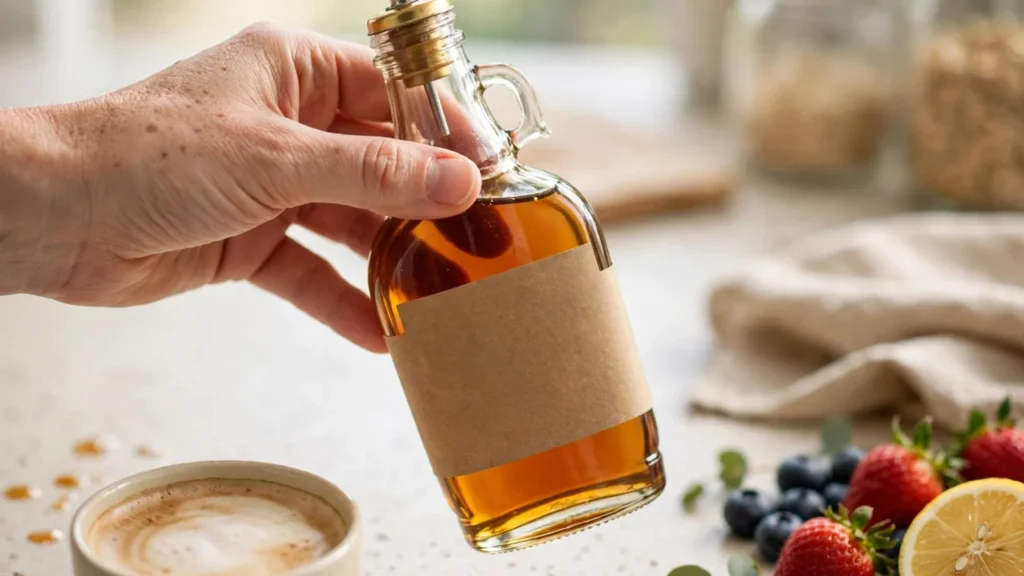
Sodium benzoate and potassium sorbate are antimicrobial preservatives. In plain terms, they slow mold, yeast, and some bacteria so an opened, sugar-rich bottle stays usable longer.
Torani prints them with the note “to preserve freshness,” which is accurate but incomplete without context. They are functional ingredients, not flavor ingredients. You are not tasting them in any meaningful way at normal use levels.
Both are widely used across the food industry and are generally recognized as safe (GRAS) by the U.S. Food and Drug Administration when used within approved limits. That regulatory status does not make them “natural” — it makes them permitted food additives.
There are two nuances worth knowing. First, sodium benzoate can, under certain conditions involving vitamin C and heat or light, form benzene. Food makers control for this, and it is not a reason to assume a normal serving of syrup is dangerous, but it is a reason some shoppers prefer to avoid the ingredient altogether.
Second, a small number of people report sensitivity to benzoates or sorbates. If you notice a pattern after using preserved drinks, switching to Puremade — which omits both — is a simple test, not a medical diagnosis.
If storage is your main concern, our guide on whether Torani syrups need to be refrigerated explains opened-bottle handling in more detail.
Dyes Explained: Caramel Color vs. FD&C Colors
Not all color on a Torani label means the same thing. Caramel color is made by heating sugars, often with an acid or alkali. FD&C colors, by contrast, are synthetic, petroleum-derived dyes that the FDA certifies batch by batch.
Common FD&C dyes seen on Torani labels include FD&C Red #40 in strawberry, cherry, and watermelon-style flavors, FD&C Blue #1 in blue raspberry, and FD&C Yellow #5 and Yellow #6 in some peach and citrus-style flavors. Exact dyes vary by flavor, so check each bottle.
These dyes are approved for food use in the United States when used as directed. At the same time, they are the ingredients most likely to push a shopper away from calling a syrup “natural.” They are also the focus of ongoing debate: some studies and reviews have raised questions about behavior in sensitive children, and the European Union requires a warning label on foods containing Red 40, Yellow 5, or Yellow 6.
In 2025, the FDA also revoked authorization for FD&C Red #3 in food and announced plans to work with manufacturers to phase out the remaining synthetic dyes. That changing landscape is another reason to check current labels rather than relying on an old bottle.
Bottom line: if you want to avoid synthetic dyes, skip brightly colored Original fruit flavors unless the label confirms no FD&C color, and choose Puremade or a naturally colored flavor instead.
Dye decoder: what the label words mean
| Label term | What it is | Natural? |
|---|---|---|
| Caramel color | Heated-sugar color, widely used in vanilla, caramel, and cola-style drinks | Processed, not synthetic dye — but not “nothing added” |
| FD&C Red #40 | Synthetic red dye (Allura Red AC) | No |
| FD&C Blue #1 | Synthetic blue dye (Brilliant Blue FCF) | No |
| FD&C Yellow #5 / #6 | Synthetic yellow/orange dyes (Tartrazine / Sunset Yellow) | No |
| Fruit juice (for color) | Juice used to tint, seen in some Puremade Zero Sugar products | Closer to natural coloring |
Are Puremade Syrups Really Natural?
Puremade is Torani’s cleanest answer to this question. Torani describes Puremade syrups as GMO-free with no artificial flavors, colors, or preservatives.
The Signature Vanilla ingredient list shows why: pure cane sugar, water, natural flavors, and citric acid. No sodium benzoate, no potassium sorbate, no caramel color, and no FD&C dye.
That does not make Puremade an unprocessed food. It is still a sweetened syrup, and citric acid is a processed acidulant even when it occurs naturally in citrus. But on the specific question of dyes and preservatives, Puremade clears the bar that Original does not.
Puremade Zero Sugar is a separate case. It also claims no artificial sweeteners, preservatives, colors, or flavors, and is sweetened with erythritol, stevia, and monk fruit. Its ingredient list is longer — including inulin, pectin, and xanthan gum — because sugar-free texture needs more help.
If you want the simplest label, choose a regular Puremade flavor, not a zero-sugar one. If you want zero sugar, Puremade Zero Sugar is still a step up from Sugar Free Original on the artificial-ingredient question.
Nutrition Chart: What a Serving Actually Contains
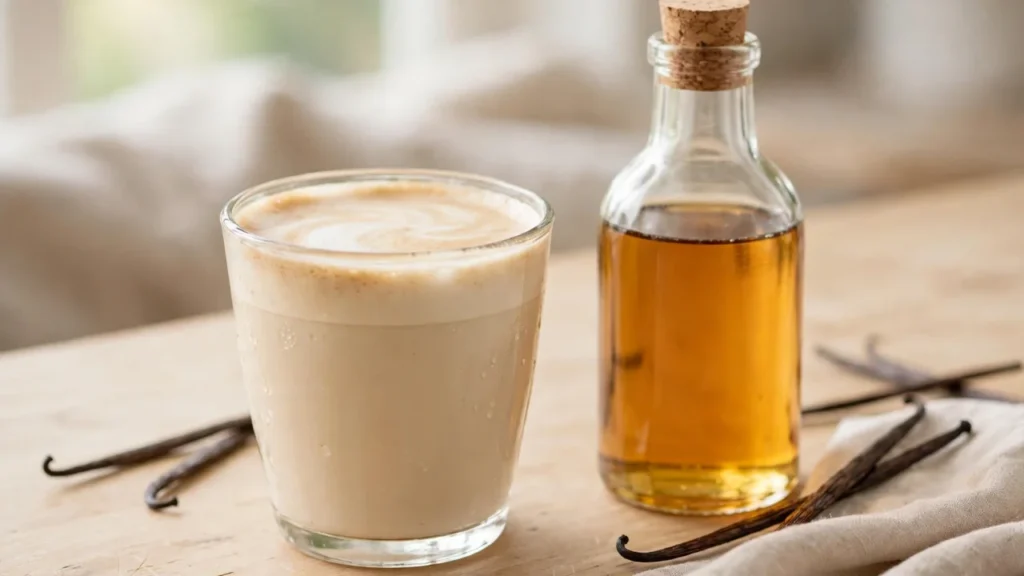
Most regular Torani syrups, Original and Puremade alike, use the same serving size: 2 tablespoons (30 ml). A 750 ml bottle therefore holds about 25 servings.
The table below uses Torani’s published figures for French Vanilla and Cherry as representative regular syrups. Individual flavors vary, especially sugar-free versions, so check your flavor’s panel.
| Per 2 tbsp (30 ml) | Original French Vanilla / Cherry | Puremade Vanilla | Sugar Free Original (typical) |
|---|---|---|---|
| Calories | 80 | 80 | 0 |
| Total fat | 0 g | 0 g | 0 g |
| Sodium | 0 mg | 0 mg | Varies by flavor, often 15–80 mg |
| Total carbohydrate | 20 g | 20 g | 0 g |
| Total sugars / added sugars | 20 g / 20 g | 20 g / 20 g | 0 g |
| Protein | 0 g | 0 g | 0 g |
“Natural” and “low-calorie” are different questions. Puremade still contains 20 grams of sugar per serving, just like Original. If sugar is your main concern, that matters more than the dye question — and our Is Torani Syrup Healthy? and Is Torani Syrup Keto? guides break down both angles.
Allergens: What to Watch For
Most plain Torani syrups list no major allergen, but flavor-specific ingredients change that fast. Nut flavors can contain tree nut, and creamy sauces can contain milk. Torani’s own Puremade Hazelnut listing, for example, notes that it contains tree nut (hazelnut).
Sugar-free and sauce lines can also include gums and dairy-derived ingredients. If you have a nut, milk, or other food allergy, do not rely on a general guide — read the allergen statement on your exact bottle, every time.
For people avoiding gluten, Torani lists many syrups as gluten-free, but again, the bottle label is the authority. Formulations and facility statements can change.
How to Read a Torani Label in 20 Seconds
Start at the end of the ingredient list, not the beginning. The first ingredients will almost always be sugar and water. The decisions live in the last few lines.
- Look for “Puremade.” That word on the front is the fastest clean-label signal in the Torani range.
- Scan for benzoate and sorbate. Sodium benzoate or potassium sorbate means the syrup is preserved, even if everything else looks simple.
- Scan for FD&C. Any “FD&C” entry means a synthetic dye is present, regardless of how natural the fruit name sounds.
- Check caramel color separately. It is not an FD&C dye, but it is still an added color. Decide whether that matters to you.
- Check the sweetener. Cane sugar means regular calories. Sucralose or acesulfame potassium means sugar-free Original, not Puremade.
Your closest-to-natural shopping checklist
- ✅ Choose Puremade for no artificial flavors, colors, or preservatives
- ✅ Prefer flavors with fruit juice or no added color over bright FD&C-colored flavors
- ✅ Use 1–2 tablespoons per drink — see how much Torani syrup to use for ratios
- ⚠️ Avoid Sugar Free Original if your goal is avoiding artificial sweeteners
- ⚠️ Double-check nut and dairy flavors for allergen statements
- 📸 Photograph the label before you buy a new flavor, so you can compare it at home
Price Snapshot: Does Natural Cost More?
Prices observed on 30 October 2026 suggest a typical U.S. range of about $8–$15 for a single 750 ml bottle, depending on flavor, retailer, and whether a pump or multipack is included. Grocery stores often sit at the lower end for best-selling flavors, while specialty and online listings can sit higher.
Puremade bottles often land at or slightly above the middle of that range, not dramatically higher. Variety packs can lower the per-bottle cost, but always check the exact line — a “variety pack” may mix Original and Puremade, or regular and sugar-free, bottles.
Prices change frequently, and third-party sellers can charge well above the typical range. Check current listings before buying, and be wary of any listing that does not show the full ingredient list or product line.
For where to shop, see our where to buy Torani syrup guide.
Common Myths, Corrected
Myth: “Natural flavors” means the syrup is natural
False. Natural flavors are one ingredient category. Preservatives and colors are separate decisions, and a bottle can have natural flavors plus both.
Myth: All Torani syrups contain artificial dyes
False. Many coffee flavors contain no FD&C dye at all, and Puremade avoids artificial colors entirely. Bright fruit flavors are the most likely to contain them.
Myth: Preservative-free means it never goes bad
False. Removing preservatives can shorten usable life after opening. Store Puremade as directed, watch for off smells or mold, and do not keep an opened bottle indefinitely.
Myth: Sugar-free means more natural
False. Sugar Free Original replaces sugar with sucralose and acesulfame potassium and usually keeps preservatives and, in some flavors, dyes. Puremade Zero Sugar is the cleaner sugar-free option in Torani’s range.
Which Torani Should You Buy?
Choose Puremade if your priority is the shortest, least-artificial ingredient list and you are happy with regular sugar. Choose Original if you want the widest flavor choice, the classic café taste, and you are comfortable with preservatives and occasional FD&C color.
Choose Puremade Zero Sugar if you want zero sugar without artificial sweeteners, colors, or preservatives. Choose Sugar Free Original only if price and availability matter more than avoiding artificial sweeteners and preservatives.
Whichever line you pick, try it first in a simple drink — a latte, an Italian soda, or sparkling water — so you can judge flavor without other ingredients masking it. Our Torani syrup for cocktails guide is a good next step if you want to use the same bottle beyond coffee.
Frequently Asked Questions
Are Torani syrups natural?
Some are closer than others. Puremade syrups contain no artificial flavors, colors, or preservatives. Most Original syrups contain preservatives, and some contain FD&C dyes, so they are not fully natural.
Do Torani syrups contain artificial dyes?
Some do and some do not. Bright fruit flavors such as cherry, strawberry, and blue raspberry often list FD&C Red #40 or FD&C Blue #1. Many coffee flavors and all Puremade syrups do not use artificial dyes.
Do Torani syrups contain preservatives?
Most Original and Sugar Free Original syrups contain sodium benzoate and potassium sorbate, labeled “to preserve freshness.” Puremade syrups do not claim artificial preservatives.
What is sodium benzoate in Torani syrup?
Sodium benzoate is an antimicrobial preservative that slows mold, yeast, and some bacteria in acidic drinks and syrups. It is generally recognized as safe within approved limits, but it is not a natural ingredient.
What is potassium sorbate in Torani syrup?
Potassium sorbate is a preservative that mainly targets mold and yeast. It is widely used in food and is generally recognized as safe within approved limits.
Is caramel color natural?
Caramel color is made by heating sugars, so it is not a synthetic FD&C dye. It is still a processed added color, and shoppers who want no added color should choose a flavor without it.
Are Torani Puremade syrups gluten-free?
Torani describes Puremade syrups as GMO-free and gluten-free in many listings. Always confirm on your exact bottle, because formulations and labels can change.
Do Torani syrups contain high-fructose corn syrup?
Regular Torani syrups are sweetened with pure cane sugar, not high-fructose corn syrup, according to Torani product pages. Sugar-free versions use sweeteners instead of cane sugar.
Are Torani syrups vegan?
Many fruit and coffee syrups contain no animal-derived ingredients, but creamy sauces and some flavors may contain milk. Check the allergen statement on your exact flavor before assuming it is vegan.
Can children drink Torani syrups?
Torani syrups are sweetened drinks, not health drinks, and bright FD&C-colored flavors are the ones most often questioned for sensitive children. If dye sensitivity is a concern, choose Puremade or a dye-free flavor and keep servings small.
How long does Puremade last without preservatives?
Puremade has no artificial preservatives, so follow the bottle’s storage directions, keep it clean and capped, and discard it if it smells off, tastes off, or shows mold. Do not assume it lasts as long as a preserved bottle.
Where can I check a Torani ingredient list?
Start with the bottle label, then Torani’s official product page for that flavor. Torani notes that labels may vary with packaging updates, so the bottle you buy is the final authority.
Key Takeaways
- Torani is not one ingredient list — Original, Puremade, and Sugar Free Original differ sharply on dyes and preservatives.
- Puremade is the closest-to-natural Torani line, with no artificial flavors, colors, or preservatives.
- Most Original syrups use sodium benzoate and potassium sorbate; some bright flavors add FD&C dyes.
- Read the last few ingredients, not just the flavor name, before you buy.
- Puremade still contains sugar, so “more natural” does not mean low-calorie.
Next, try a Puremade flavor in your usual latte and compare it side by side with your current Original bottle. The flavor difference is often smaller than the label difference — and that is exactly the point.
Sources checked 30 October 2026: Torani official product pages for Cherry, French Vanilla, and Puremade Signature Vanilla; Torani Puremade Zero Sugar listings; FDA color-additive and preservative guidance summaries. Prices are typical observed ranges, not live retailer quotes — check current listings before buying.