Is Torani Syrup Bad for You? The Honest, Evidence-Based Answer
Is Torani syrup bad for you? In small amounts, no. A pump or two in your coffee is a modest treat, not a health hazard. But a full ounce of classic Torani syrup packs 19 grams of sugar, which is most of a day’s recommended added sugar in a single drink.
The honest answer depends on which Torani you buy, how much you pour, and how often you drink it. Torani syrup is not poison, and it is not a health food either.
It sits in the same category as table sugar, honey, and flavored coffee creamer: fine as an occasional flavor boost, and a problem only when it becomes a daily sugar habit. This guide breaks down exactly what is inside the bottle, what the science says about the sweeteners, and how to enjoy Torani without blowing your sugar budget.
This article is general information, not medical advice. If you have diabetes or another condition affected by sugar, talk to your doctor or a dietitian about what fits your plan.
The Short Answer: It Depends on How Much You Use
Torani syrup is bad for you only in the same way sugar is bad for you. The classic version is mostly sugar and water, so its health impact is the health impact of added sugar. One pump in a morning latte adds about 20 calories and 5 grams of sugar, which is a small addition to most diets. A large flavored drink with four or five pumps can add 80 to 100 calories and 20 to 25 grams of sugar, which is nearly a full day of added sugar in one cup.
The sugar-free version removes the sugar problem entirely, but it replaces sugar with artificial sweeteners. Those sweeteners are approved by regulators in the United States and Europe, and the amounts in a normal serving sit far below the official daily limits. Some health bodies, including the World Health Organization, still advise against relying on non-sugar sweeteners for weight control, so the sugar-free route is a trade-off rather than a free pass.
So the fair summary is this: Torani syrup is not inherently dangerous, it is not nutritious, and the dose makes the difference. A little, occasionally, is fine for most healthy adults. A lot, every day, works against your health goals in the same way any daily added sugar does.
What Is Torani Syrup, Exactly?
Torani is a flavored syrup made by R. Torre and Company, a family business based in South San Francisco, California. The company has made syrups since 1925, and its bottles are a fixture in coffee shops across the United States. The syrups flavor coffee, lattes, Italian sodas, lemonade, cocktails, and desserts.
There are three main Torani lines, and they are very different from a health point of view. The Classic line is sweetened with pure cane sugar. The Sugar Free line replaces sugar with sucralose and acesulfame potassium. The Puremade line uses real sugar in the standard version, while Puremade Zero Sugar is sweetened with stevia, erythritol, and monk fruit.
Knowing which line you are pouring matters more than which flavor you pick, because the sweetener is what decides the calories and the sugar.
Torani also makes sauces, such as caramel sauce and dark chocolate sauce. Sauces are thicker, richer, and usually higher in calories than syrups, so they deserve their own portion care. For a full breakdown of how the product lines differ, see our guide to Torani syrup ingredients explained.
Torani Syrup Nutrition Facts: Classic vs Sugar Free vs Puremade Zero
The numbers below come from the USDA food database and from Torani bottle labels, for a standard serving of 2 tablespoons, which is 1 fluid ounce or 30 ml. That is the serving size printed on the label. Note that a single pump from a Torani pump dispenser is much smaller, about a quarter of an ounce, so one pump is roughly a quarter of these numbers.
| Per 1 fl oz (30 ml) | Classic | Sugar Free | Puremade Zero Sugar |
|---|---|---|---|
| Calories | 80 | 0 | 0 |
| Total carbohydrates | 20 g | 0-1 g | 0 g sugars (8 g erythritol) |
| Total sugars | 19 g | 0 g | 0 g |
| Added sugars | 19 g | 0 g | 0 g |
| Fat | 0 g | 0 g | 0 g |
| Protein | 0 g | 0 g | 0 g |
| Sodium | 0 mg | 5-10 mg | 5 mg |
| Main sweetener | Pure cane sugar | Sucralose, acesulfame K | Stevia, erythritol, monk fruit |
The table tells the whole story in one glance. Classic Torani is a sugar delivery system: 80 calories and 19 grams of sugar per ounce, with no fiber, no protein, and no vitamins to slow the sugar down or add nutrition. The sugar-free lines cut the calories and sugar to zero, but they do it with sweeteners that carry their own debate, which we cover below.
Serving size 2 tablespoons (1 fl oz / 30 ml). Figures from the USDA database and Torani labels. A standard pump is about a quarter of this serving.
How Much Sugar Is in Your Drink?
Most people do not drink Torani by the ounce. They use pumps, and the pump count is where the sugar hides. A standard Torani pump dispenses about a quarter of a fluid ounce, which is roughly 5 grams of sugar and 20 calories for the classic syrup.
A small latte with one pump is a light touch. A large iced coffee with four pumps holds about 20 grams of sugar and 80 calories from syrup alone, before milk or whipped cream.
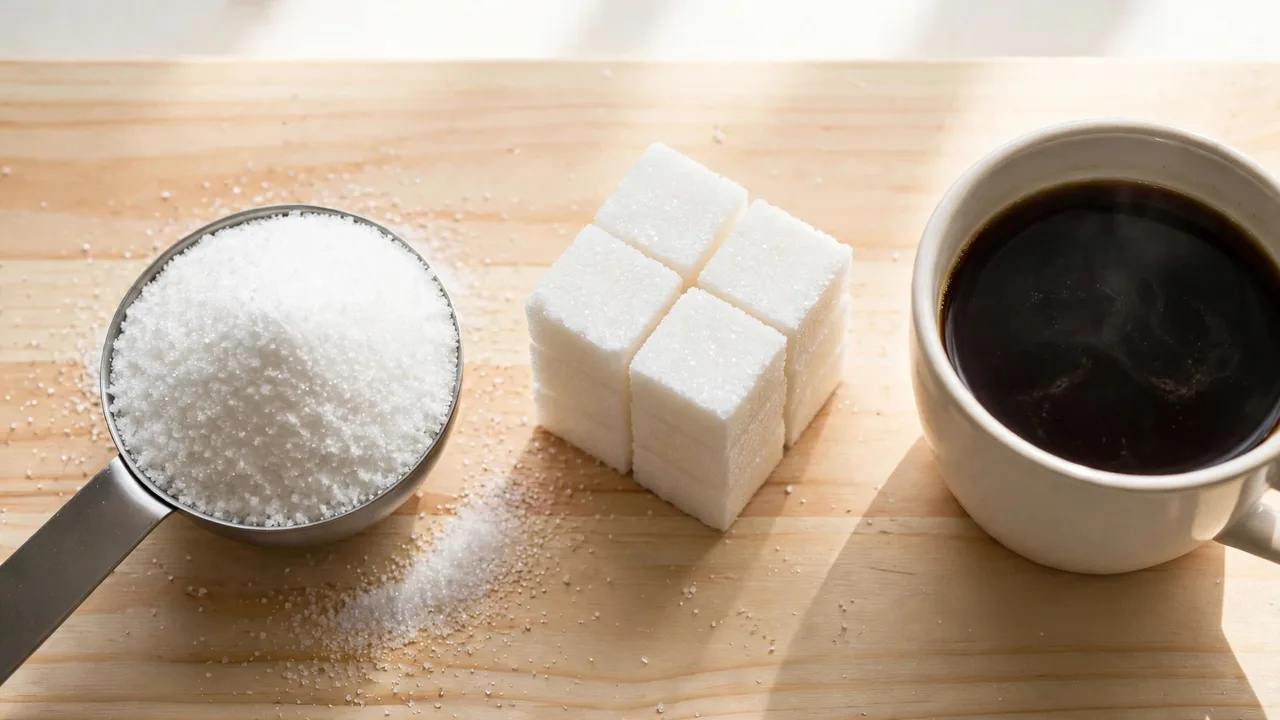
To see why that matters, compare it with the daily limits from the American Heart Association. The AHA recommends no more than 25 grams of added sugar a day for most women and 36 grams for most men. The World Health Organization recommends keeping free sugars under 10 percent of daily calories, and ideally under 5 percent, which works out to about 25 grams on a 2,000-calorie diet.
That means a single full ounce of classic Torani, 19 grams of sugar, uses up about three quarters of a woman’s daily added sugar budget and more than half of a man’s. Two pumps, about 10 grams, is a much kinder share at 40 percent of the women’s limit and 28 percent of the men’s. The chart below makes the comparison visual.
American Heart Association daily added-sugar limits, and how Torani servings compare.
Pump figures are estimates based on a standard pump dispensing about a quarter of a fluid ounce. Actual pumps vary slightly by brand and model.
Why Added Sugar Is the Real Issue
Torani syrup itself contains no poison. Its problem is the same problem as any added sugar: it adds calories without adding nutrition, and it is easy to consume a lot of it without noticing. Added sugar is linked in research to weight gain, tooth decay, and a higher risk of type 2 diabetes and heart disease when eaten in large amounts over time. The risk comes from the total pattern of your diet, not from one flavored coffee.
Liquid sugar deserves extra attention because it does not fill you up. A spoonful of sugar in coffee disappears into the drink, and your body barely registers the calories. Studies on sugary drinks consistently show that people do not eat less later to make up for the calories they drank. A flavored latte every morning can quietly add 100 calories a day, which is 700 a week, without ever feeling like a meal.
There is also the blood sugar angle. Because Torani syrup is pure sugar dissolved in water, with no fiber or protein to slow it down, it raises blood sugar quickly. For most healthy people that spike is brief and harmless.
For people with diabetes or insulin resistance, it matters a great deal more, and the sugar-free line is usually the better choice. Our guide on whether Torani syrup is keto covers the blood sugar question in more detail.
Does Torani Syrup Cause Weight Gain?
Torani syrup does not cause weight gain by itself. Weight gain comes from eating more calories than you burn over time, and Torani is simply one source of calories. But it is a sneaky one: a daily large flavored coffee with four pumps adds about 80 calories, and if nothing else in your diet changes, that is roughly 8 pounds of weight gain over a year. Cutting the pumps in half, or switching to sugar-free, removes most of that without giving up the flavor.
Is Torani Syrup Bad for Your Teeth?
Yes, in the same way any sugary drink is. Sugar feeds the bacteria in your mouth that produce acid, and acid wears down tooth enamel. Sipping a sweetened iced coffee slowly over an hour keeps your teeth in contact with sugar for longer, which is worse than drinking it quickly. Rinsing with water after a sweetened drink, and not brushing for about 30 minutes so your enamel can reharden, are simple habits that help.
What About Sugar-Free Torani? Is It Safer?
Sugar-free Torani removes the sugar and the calories, which solves the biggest health problem of the classic syrup. The trade-off is the sweetener system: sucralose, sold as Splenda, plus acesulfame potassium, often shortened to ace-K. Both are approved food additives, and both have official daily limits set far above what a normal serving contains.
Sucralose was approved by the US Food and Drug Administration in 1998 and as a general-purpose sweetener in 1999. The FDA sets its acceptable daily intake at 5 milligrams per kilogram of body weight per day. For a 60-kilogram adult, that is about 300 milligrams a day, which the FDA illustrates as roughly 23 tabletop packets.
European regulators and the joint WHO and FAO expert committee set a higher limit of 15 milligrams per kilogram. A serving of sugar-free Torani contains only a small fraction of these limits, because sucralose is about 600 times sweeter than sugar and very little is needed.
Acesulfame potassium has been approved in the United States since 1988. Regulators set its daily limit at 15 milligrams per kilogram of body weight. It is used alongside sucralose because the two sweeteners cover each other’s taste gaps: sucralose gives body, ace-K gives a fast sweet hit. Neither one raises blood sugar, which is why sugar-free Torani works for low-carb and keto diets.
What the WHO Said in 2023
In May 2023, the World Health Organization issued a guideline advising against the use of non-sugar sweeteners for weight control or for reducing the risk of chronic disease. The advice covered sucralose, acesulfame K, aspartame, saccharin, and stevia as a group. The recommendation was conditional, which is the WHO’s weaker category, and it rested on evidence the WHO itself graded as low certainty.
The key point is what the guideline did not say. It did not declare sucralose unsafe, and it did not change any acceptable daily intake. It said that swapping sugar for sweeteners does not reliably help people lose weight or keep it off over the long term, and that long-term heavy use was linked in some observational studies to higher risks of type 2 diabetes and heart disease.
Those links cannot prove cause and effect, because people who use a lot of sweeteners often differ in other ways from people who do not. The guideline also does not apply to people who already have diabetes, who were outside its scope.
Our take: sugar-free Torani is the better choice if your goal is cutting sugar and calories, especially if you have diabetes or watch your blood sugar. It is not a health food, and it is not a weight-loss tool. If you use one or two pumps a day, you are far below every regulatory limit. If you drink sweetened drinks all day long, the WHO advice is a good reason to cut back on sweetness in general, not just on one brand.
Does Sucralose Harm Your Gut?
This is the most common worry about sugar-free Torani, and the honest answer is that the evidence is mixed and early. A small 2022 study found that sucralose changed gut bacteria and slightly reduced insulin sensitivity in some healthy adults over two weeks. Other studies found no meaningful effect.
Regulators who reviewed the full body of evidence, including the European Food Safety Authority in a 2026 re-evaluation, kept the existing daily limits in place. If gut health is a priority for you, the Puremade Zero Sugar line, sweetened with stevia and erythritol, is the gentler option, or you can rotate sugar-free Torani with unsweetened drinks.
The Other Ingredients: Preservatives, Colors and “Natural Flavors”
Classic Torani has a short ingredient list: pure cane sugar, water, natural flavors, citric acid, sodium benzoate and potassium sorbate to preserve freshness. Some flavors add caramel color, and some fruit flavors add FD&C food colors such as Red 40. Sugar-free versions add xanthan gum for body and use sucralose and acesulfame potassium instead of sugar.
Sodium benzoate and potassium sorbate are preservatives that stop mold and yeast from growing in the bottle. Both are approved worldwide and have been used in food for decades. They are the reason an opened bottle of Torani lasts for months without refrigeration.
Some people worry about sodium benzoate forming benzene when mixed with vitamin C, but that reaction needs heat, light, and time, and the levels in flavored syrup are far below any concern threshold. For a deeper look at each ingredient, see are Torani syrups natural.
“Natural flavors” is the vaguest item on the label. Under US rules, it means flavor compounds derived from a natural source, such as a plant or spice, rather than made in a lab. It does not mean the flavor comes from the fruit on the label.
A strawberry syrup’s flavor may come from natural strawberry compounds, but it may also come from other plant sources that taste like strawberry. The term is legal and standard across the food industry, but it tells you very little about what is actually in the bottle.
Caramel color is used in flavors such as vanilla, caramel, and hazelnut to give the syrup its golden brown look. It is one of the most widely used food colors in the world. Some caramel colors contain a compound called 4-MEI, which California lists as a possible concern at very high doses. The amounts in flavored syrup are tiny compared with the doses studied, and regulators in the US and Europe consider caramel color safe at normal food levels.
Allergens and Who Should Be Extra Careful
Most Torani syrups contain no major allergens. The exceptions are the nut flavors. Torani hazelnut syrup, for example, carries a label warning that it contains hazelnut and peanut allergens.
If you have a tree nut or peanut allergy, check the label of every flavor, because nut flavors are made on shared equipment and cross-contact is possible. Torani also makes a peanut butter syrup, which is an obvious one to avoid if you have a peanut allergy.
Torani syrups are gluten-free by formulation. Torani states that its syrups are gluten-free, and our guide to whether Torani syrup is gluten-free covers the details. People with celiac disease should still check the label of each new flavor, because formulations can change.
Three groups should be more careful than most. People with diabetes should favor the sugar-free or Puremade Zero lines, because classic Torani is fast-acting sugar. Children should have flavored syrups only as an occasional treat, because their daily added sugar limit is lower than an adult’s and sweet drinks train a preference for sweetness. Pregnant people can use Torani in normal amounts, but the same sugar logic applies, and anyone with a medical condition should ask their clinician rather than trusting a blog post.
How Much Torani Syrup Is OK Each Day?
There is no official daily limit for Torani syrup itself, because regulators limit added sugar as a whole, not one product. The practical way to think about it is to count your Torani sugar against the American Heart Association limit: 25 grams a day for most women, 36 grams for most men. If your coffee holds two pumps of classic Torani, about 10 grams, you still have room for the rest of the day’s sugar. If it holds five pumps, about 25 grams, your whole day’s budget is gone before breakfast is over.
The table below gives a simple daily guide for classic Torani. It assumes the rest of your diet is average and that you are a healthy adult. Adjust down if you eat a lot of other sweet foods, and talk to your clinician if you have diabetes or another condition.
| Daily habit | Pumps of classic Torani | Sugar from Torani | Verdict |
|---|---|---|---|
| One small coffee, light flavor | 1 | About 5 g | Easy fit for almost everyone |
| One regular latte | 2 | About 10 g | Reasonable daily treat |
| One large flavored drink | 3-4 | About 15-20 g | Most of the day’s sugar budget |
| Two large flavored drinks | 6-8 | About 30-40 g | Over the daily limit on syrup alone |
| Any amount, sugar free | 1-4 | 0 g | No sugar, but watch total sweetener use |
If you drink Torani every day, the simplest upgrade is to drop from three pumps to two, or from two to one, and let your taste buds adjust over a week or two. Most people find they enjoy the coffee more, not less, once the sweetness stops covering the coffee flavor. For exact ratios per drink size, see how much Torani syrup to use.
7 Ways to Make Torani Healthier
You do not have to give up Torani to use it wisely. These seven habits keep the flavor and cut the downside.
- Count your pumps. Use a pump dispenser instead of free pouring. One pump is about a quarter ounce, and it is easy to pour three times that amount by eye. If you want to know whether a pump is worth buying, read do you need a syrup pump for Torani.
- Halve the sweetness, keep the flavor. Try one pump where you used two. After a week your palate adjusts, and the old amount will taste too sweet.
- Mix classic with sugar free. One pump of classic plus one pump of sugar free gives you real sugar flavor with half the sugar. It is the easiest compromise for people who dislike the taste of sucralose on its own.
- Try Puremade Zero Sugar. If you want zero sugar without sucralose, the stevia and erythritol blend is the closest thing Torani makes to a natural sugar-free option.
- Use it in water, not just coffee. A pump of fruit syrup in sparkling water is a lighter treat than a sweetened latte with milk and whipped cream, and it still feels like a flavored drink. Our best sugar-free Torani syrups for coffee list includes flavors that work well in both.
- Save the big drinks for weekends. A large caramel latte with four pumps and whipped cream is a dessert, not a daily coffee. Enjoy it as one, and keep weekdays lighter.
- Rinse with water after sweet drinks. A quick rinse protects your teeth, and it costs nothing.

Same flavor, less sugar. Pick one swap and try it for a week.
Torani Syrup Prices: What a Bottle Costs
Torani is a mid-priced syrup. A single 750 ml bottle, which is 25.4 fluid ounces, usually costs between 7 and 14 dollars at major US retailers, and the 12.7-ounce bottle usually costs between 5 and 6 dollars. Prices vary by flavor, seller, and whether the bottle comes with a pump.
The table below shows prices observed on November 13 and 14, 2026. Always check the current listing before you buy, because syrup prices move often and third-party sellers on Amazon can charge much more than the big retailers.
| Product | Retailer | Price observed | Observed |
|---|---|---|---|
| Torani Vanilla, 12.7 fl oz | Amazon | $4.92 | Nov 14, 2026 |
| Torani Vanilla, 12.7 fl oz | Walmart | $5.17 | Nov 14, 2026 |
| Torani Vanilla, 12.7 fl oz | Target | $5.19 | Nov 14, 2026 |
| Torani Vanilla, 25.4 fl oz | Walmart | $6.95 | Nov 14, 2026 |
| Torani Vanilla, 25.4 fl oz | Amazon | $14.42 | Nov 14, 2026 |
| Torani Vanilla, 25.4 fl oz, 4-pack | Amazon | $25.92 (about $6.48 per bottle) | Nov 14, 2026 |
| Torani Vanilla, 750 ml, 2-pack | Amazon | $24.94 | Nov 13, 2026 |
| Torani Sugar Free Lime, 750 ml | Amazon | $17.04 | Nov 13, 2026 |
The spread is the story. The same 25.4-ounce bottle of vanilla cost 6.95 dollars at Walmart and 14.42 dollars on Amazon on the same day, which is more than double. The 4-pack on Amazon worked out to about 6.48 dollars a bottle, which was the best value of the group.
Sugar-free flavors tend to cost a little more than classic flavors, and less common flavors can cost more still. Buying the larger bottle and adding a reusable pump is usually the cheapest way to keep Torani at home.
Classic vs Sugar Free vs Puremade Zero: Which Is Least Bad?
There is no single winner, because the three lines trade different risks. Classic Torani is the most natural in the sense that its sweetener is plain cane sugar, but it is also the only one that adds real sugar and calories to your day. Sugar-free Torani is the best choice for blood sugar and calories, but it leans on artificial sweeteners that some people prefer to limit. Puremade Zero Sugar splits the difference with plant-based sweeteners and no sucralose, but it costs more and comes in fewer flavors.
| Classic | Sugar Free | Puremade Zero Sugar | |
|---|---|---|---|
| Sugar per ounce | 19 g | 0 g | 0 g |
| Calories per ounce | 80 | 0 | 0 |
| Sweetener | Pure cane sugar | Sucralose, acesulfame K | Stevia, erythritol, monk fruit |
| Blood sugar impact | Raises it quickly | None | None |
| Best for | Occasional treat, baking, cocktails | Daily coffee, diabetes, keto | Daily use without artificial sweeteners |
| Watch out for | Sugar adds up fast | WHO advises against relying on sweeteners for weight control | Higher price, fewer flavors |
If you drink one flavored coffee a day and want the simplest healthy choice, sugar-free Torani or Puremade Zero Sugar wins on the numbers. If you only use Torani on weekends, the classic version in a small dose is perfectly reasonable, and many people prefer its taste. The worst choice is not a product line at all. It is the habit of pouring a lot of classic syrup into every drink, every day, without counting it.
Myth vs Fact
Myth: Torani syrup is toxic because it contains chemicals. Fact: the ingredients in Torani, including its preservatives and sweeteners, are approved food additives with decades of safety data. The dose matters far more than the presence of a chemical name on the label.
Myth: Sugar-free Torani is completely safe because it has zero calories. Fact: zero calories is not the same as zero concern. The sweeteners are approved within daily limits, but the WHO advises against relying on them for weight control, and heavy daily use is not a health strategy.
Myth: One pump of Torani is basically nothing. Fact: one pump is small, about 5 grams of sugar and 20 calories, but four pumps in a large drink is 20 grams of sugar, which is most of a day’s added sugar budget for most women.
Myth: Natural flavors mean the syrup is made from real fruit. Fact: natural flavors are flavor compounds from natural sources, but they do not have to come from the fruit named on the bottle. The syrup is flavored, not fruit juice.
Myth: Torani syrup must be bad because it is so sweet. Fact: sweetness alone does not make a food bad. The question is how much sugar you take in across the whole day, and whether the syrup fits inside that budget.
Frequently Asked Questions
Is Torani syrup bad for you?
Not in small amounts. Classic Torani is mostly sugar and water, so its health impact is the impact of added sugar: fine as an occasional flavor boost, and a problem only in large daily amounts. Sugar-free Torani has no sugar or calories, and its sweeteners are approved by regulators within daily limits.
How much sugar is in Torani syrup?
Classic Torani has 19 grams of sugar per fluid ounce, or about 5 grams per pump. Sugar-free Torani and Puremade Zero Sugar have 0 grams of sugar.
Is sugar-free Torani syrup healthy?
It is healthier than the classic version on sugar and calories, because it has none of either. It is not a health food. It is sweetened with sucralose and acesulfame potassium, which regulators consider safe within daily limits, though the WHO advises against relying on non-sugar sweeteners for weight control.
Does Torani syrup have caffeine?
No. Torani syrup itself contains no caffeine. If your drink has caffeine, it comes from the coffee, tea, or energy drink you add the syrup to.
Is Torani syrup bad for diabetics?
Classic Torani raises blood sugar quickly because it is pure added sugar, so people with diabetes should use it rarely and in small amounts, if at all. Sugar-free Torani and Puremade Zero Sugar do not raise blood sugar, and they are usually the better choice. Anyone with diabetes should check with their clinician about what fits their plan.
Does Torani syrup expire?
An unopened bottle lasts about two years from production. Once opened, classic Torani keeps well for months at room temperature thanks to its preservatives, and sugar-free versions keep for a similar time. Check the best-by date on the bottle and discard syrup that smells off or shows mold.
Is Torani syrup vegan?
Most Torani syrups are vegan, including the classic and sugar-free lines. A few flavors, such as those with honey or dairy notes, may not be. Check the label of the specific flavor, because formulations vary.
Is Torani syrup gluten-free?
Yes. Torani states that its syrups are gluten-free by formulation. Check the label of each new flavor, because formulations can change.
How many calories are in a pump of Torani syrup?
One pump of classic Torani, about a quarter of a fluid ounce, has about 20 calories. One pump of sugar-free Torani or Puremade Zero Sugar has 0 calories.
What is the healthiest Torani syrup?
Puremade Zero Sugar is the cleanest option on paper: zero sugar, zero calories, and sweeteners from stevia, erythritol, and monk fruit instead of sucralose. Sugar-free Torani is a close second and comes in far more flavors. The healthiest choice of all is the smallest dose of whichever line you enjoy.
The Bottom Line
Is Torani syrup bad for you? For most healthy adults, in the amounts most people actually use, no. A pump or two of classic Torani in a daily coffee is a small indulgence, not a health crisis. The trouble starts when a large flavored drink with four or five pumps becomes a daily habit, because that much added sugar crowds out the rest of your day’s budget and adds up over months and years.
Sugar-free Torani and Puremade Zero Sugar remove the sugar problem and are the smarter daily choice, especially if you watch your blood sugar or your weight. They are not health foods, and the WHO’s advice against leaning on sweeteners for weight control is worth hearing. But at one or two pumps a day, you are far below every regulatory limit.
The practical rule is simple: use less, enjoy it more. Count your pumps, try the sugar-free line for your everyday coffee, and save the big classic syrup drinks for the days they feel like a treat. If you want to compare Torani with the broader question of healthy syrups, our guide on is Torani syrup healthy is the next read.
References
- American Heart Association: How Much Sugar Is Too Much?
- USDA nutrition data for Torani Classic Caramel Syrup (via Prospre)
- Open Food Facts: Torani Classic Caramel ingredients and nutrition
- EWG Food Scores: Torani Sugar Free French Vanilla Syrup label
Prices in this article were observed on November 13 and 14, 2026, and will change. Check the current listing before you buy. This article is general information, not medical advice.