Why Do Torani Syrups Curdle in Milk? The Real Cause and How to Stop It
You pour a bright fruit syrup into cold milk, stir, and instead of a smooth pink drink you get flecks and lumps. It looks spoiled, and it is natural to wonder whether the syrup was bad or the milk had turned. In most cases, neither is true.
The short answer is acidity. Many Torani syrups contain citric acid, tartaric acid, or malic acid, and those acids can push milk proteins past the point where they stay dissolved. Heat, a large dose of syrup, and low-fat milk make the reaction more likely. The good news is that the order you mix, the milk you choose, and the amount of syrup you use can usually keep the drink smooth.
This guide explains the science in plain language, ranks which syrups and milks are riskiest, and gives tested fixes for hot lattes, iced drinks, and strawberry milk. It also covers when curdled milk is safe to strain or stir back in, and when you should throw it out.
Key takeaways
- Acid is the main trigger. Fruit-flavored Torani syrups are more likely to curdle milk than vanilla, caramel, or hazelnut.
- Heat speeds it up. The same syrup may behave in cold milk and curdle in a hot latte.
- Order matters. Mix syrup into coffee, water, or a little warm milk first, then add the rest of the milk slowly.
- Full-fat milk and cream are more forgiving than skim milk, but they are not a guarantee with very sour flavors.
- Curdled does not always mean spoiled. If the milk smelled fresh before you mixed it, acid curdling is the likely cause. If it smelled sour beforehand, discard it.
Why milk curdles: the 60-second science
Milk looks uniform, but it is really water, fat, milk sugar, and proteins living together in a delicate balance. The protein that matters most here is casein. Casein groups into tiny bundles called micelles, and those bundles normally repel each other because they carry a negative charge.
Fresh milk sits around pH 6.5 to 6.7, which is only slightly acidic. When you add acid, the pH falls. Near pH 4.6, casein reaches its isoelectric point, the point where its net charge is about zero. Without that repelling charge, the micelles stop keeping their distance and start clumping.
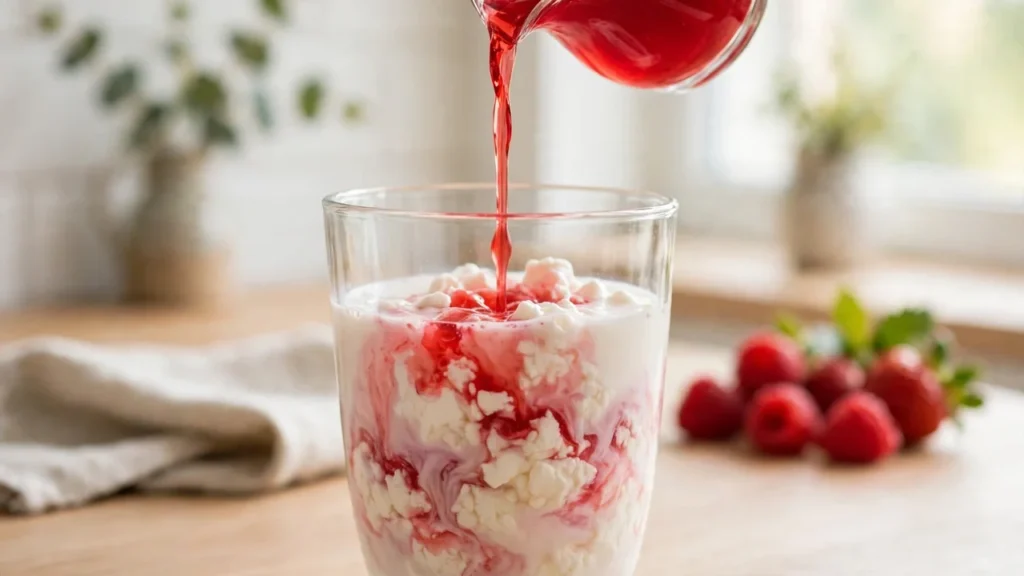
At first the change may look like cloudiness or a grainy texture. As more micelles join together, you see visible curds floating in watery whey. Heat makes the proteins move and bond faster, which is why a hot drink can curdle in seconds while a cold drink may only turn slightly grainy after sitting.
This is the same basic chemistry behind buttermilk, yogurt, and cheese. The difference is control. In cheese making, curdling is deliberate and the curds are drained and pressed. In a flavored milk, it is an accident of pH, temperature, and dose.
The pH ladder: from smooth milk to visible curds
Milk does not need to become strongly acidic to change. It only needs to move far enough toward casein’s tipping point.
You do not need a pH meter to use this. Just remember that more syrup, a more sour flavor, and more heat all push the drink further down the ladder.
Why Torani syrups can trigger it
Torani syrups are not spoiled milk, and they are not designed to curdle dairy. The issue is that many of them are flavored with fruit acids or contain acids used to brighten flavor and preserve freshness. Citric acid appears across the Torani range, including in vanilla, caramel, strawberry, cherry, and many fruit flavors. Some fruit flavors also list tartaric acid or malic acid.
That matters because the acid is concentrated in the syrup. A tablespoon or two may seem small, but it lands in one spot before you stir. If that spot is hot milk, the local pH can drop fast enough for casein to clump before the syrup dilutes.
Torani’s own flavor families make the pattern easy to predict. Coffeehouse flavors such as vanilla, caramel, and hazelnut are usually the easiest with milk. Fruit flavors such as lemon, lime, raspberry, strawberry, pomegranate, cherry lime, and passion fruit carry more sour character and are the usual suspects when milk separates.
Sugar-free syrups deserve a separate note. They still commonly list citric acid and tartaric acid, so switching to sugar-free does not remove the acid trigger. It may change sweetness and body, but it does not make a sour flavor milk-safe on its own.
Which Torani flavors are most likely to curdle milk?
No published Torani pH table covers every flavor, so treat the table below as a practical risk guide, not a laboratory ranking. It is based on the acids listed on labels and the sour character of each flavor family. Your milk, temperature, and syrup dose can move any flavor up or down a level.
| Risk level | Flavor examples | Why |
|---|---|---|
| Higher | Lemon, lime, raspberry, strawberry, pomegranate, cherry lime, passion fruit, blood orange | Strong fruit acidity, often with citric acid plus tartaric or malic acid |
| Medium | Peach, watermelon, blue raspberry, green apple, cherry | Fruity and tart, but often less sharp than citrus and berry flavors in a small dose |
| Lower | Vanilla, French vanilla, caramel, hazelnut, butter pecan, English toffee, chocolate | Sweeter, rounder profiles that are less likely to drop milk pH sharply at a normal dose |
If you love a high-risk flavor with milk, you do not have to give it up. Use the methods below, start with half your usual syrup, and taste before adding more. A smaller acid load is often the difference between smooth and split.
For a closer look at how Torani labels its ingredients, see our guide to Torani syrup ingredients explained. It is worth checking your own bottle too, because ingredient lists vary by flavor and can change over time.
Hot milk vs. cold milk: why temperature changes everything
Cold milk gives you time. Acid still lowers pH, but the proteins move slowly and you can often stir the drink and serve it before clumps grow. Hot milk removes that grace period. Heat denatures proteins, increases collisions between micelles, and makes a borderline drink curdle fast.
Coffee adds a second acid source. Brewed coffee is naturally acidic, so a fruit syrup plus hot coffee plus milk is a triple hit: syrup acid, coffee acid, and heat. That combination explains why a raspberry latte can split while the same syrup in cold milk looks fine.
Temperature shock can also play a role. Pouring ice-cold milk straight into a very hot, syrupy base can create uneven heating and local clumping. Warming the milk gently, or letting a boiling drink rest for a minute, reduces that shock without changing the flavor.
One useful rule is to never boil milk for a flavored drink. Warm it until it steams, not until it bubbles hard. If you are steaming milk for a latte, stop at a comfortable drinking temperature and mix promptly.
Is curdled milk safe to drink?
Acid curdling on its own does not turn fresh milk poisonous. If the milk was fresh, smelled normal, and was within date before you added syrup, the lumps are mostly casein that has clumped. The drink may taste sharp or feel unpleasant, but the curdling itself is a texture problem, not proof of spoilage.
That distinction has limits. If the milk already smelled sour, tasted off, or was past its date before mixing, do not rescue it. Spoiled milk can carry bacteria that acid alone does not explain, and straining will not make it safe. When in doubt, throw it out.
For a fresh-milk accident, you have three honest options. You can stir vigorously and drink it if the texture is only slightly grainy. You can strain it through a fine sieve for a smoother drink, accepting that some body will be lost. Or you can start again with a lower syrup dose and a better mixing order, which is usually the best choice for a drink you plan to serve to guests.
People with dairy allergies should note a separate point: curdling does not remove milk protein. A strained or stirred-back drink still contains dairy, and it is not safe for someone with a milk allergy.
The fix: 7 ways to keep Torani syrup and milk smooth
These methods work best together. Pick the two or three that fit your drink, rather than trying all seven at once.
1. Mix syrup into something else first
Stir the syrup into hot coffee, a splash of warm water, or a small amount of milk before adding the rest. Diluting the acid before it meets the full volume of milk lowers the local pH shock. This is the single most reliable fix for lattes.
2. Add milk last and pour slowly
Pour milk in a thin stream while stirring, instead of dumping it in all at once. Slow addition gives the acid time to disperse. For iced drinks, add syrup to the glass, add ice, then pour milk slowly over the top.
3. Use less syrup, then adjust
Start with half the syrup you normally use, stir, and taste. You can always add a little more, but you cannot un-curdle milk once it has split. Our guide to how much Torani syrup to use gives starting ratios for different drink sizes.
4. Warm milk gently and temper it
For hot drinks, warm the milk first, then whisk a spoonful of the hot syrup or coffee mixture into the milk. Once the milk is warm, combine the two slowly. Tempering avoids the cold-milk-into-boiling-liquid shock that encourages clumping.
5. Choose full-fat milk or cream for sour flavors
Fat helps shield casein and gives the drink more body, so whole milk and cream resist curdling better than skim milk. Half-and-half or a splash of heavy cream in a fruit latte is a practical compromise when you want a creamy result without a full cream drink.
6. Buffer a sour syrup with a sweeter one
Blending a sour flavor with a non-sour syrup, such as vanilla or chocolate sauce, can soften the acid hit. Try 20 ml of a sweet syrup with 10 ml of a berry syrup, then adjust to taste. This trick is used by other syrup makers for the same reason, and it keeps the fruit note while reducing the acid load.
7. Serve it cold or switch the base
If a hot fruit latte keeps splitting, make it iced, use it in soda water or lemonade instead, or use a plant milk with stabilizers. Iced drinks are more forgiving, and non-dairy bases sidestep casein altogether. Just check the plant milk label, because not all oat, soy, or almond milks behave the same way when heated.
Rescue or restart? A quick decision card
- Slightly grainy, milk was fresh: Stir hard for 20 to 30 seconds. Often good enough for a home drink.
- Visible curds, milk was fresh: Strain through a fine sieve, or blend briefly. Flavor stays, texture improves.
- Milk smelled sour before mixing: Discard it. Do not strain, blend, or serve it.
- It curdles every time: Halve the syrup, mix syrup into coffee first, and switch to whole milk or cream.
- Still splitting hot: Make it iced, or move the flavor to soda, lemonade, or a plant milk.
Three smooth recipes that use the fixes above
These recipes are built around the mixing order, not just the ingredients. Follow the order and the same flavors that split in a rushed drink usually stay smooth.
Smooth vanilla latte
Stir 1 tablespoon of vanilla syrup into hot coffee first. Steam whole milk until it is hot but not boiling, then pour it slowly into the coffee while stirring. Vanilla is a low-risk flavor, so this is a good baseline drink to learn the method.
Strawberry milk that does not split
Use cold, fresh whole milk. Stir 1 tablespoon of strawberry syrup into 2 tablespoons of milk first to make a smooth base, then pour in the remaining milk slowly. Serve immediately over ice if you like it chilled, and do not let a fruit milk sit warm for a long time.
Raspberry iced latte
Mix raspberry syrup into cold brew or chilled coffee before adding milk. Add ice, then pour cold whole milk slowly over the top and stir gently. Keeping the syrup away from hot milk removes the biggest trigger for this flavor.
For more coffee-based ideas, see our complete guide to Torani syrup for coffee. The same order-first method works for most lattes, mochas, and iced coffees on that page.

What about plant milks and cream?
Plant milks do not contain casein, so they cannot curdle in the same way. That does not make every plant milk foolproof. Some separate when heated, especially thin almond milks, while barista blends with added stabilizers usually hold up better. Oat milk made for coffee is often the safest starting point for a hot fruit latte.
| Base | Curdling risk with sour Torani | Best use |
|---|---|---|
| Skim milk | Highest among dairy milks | Low-risk flavors only, or cold drinks |
| Whole milk | Moderate | Most lattes, especially with the mix-first method |
| Half-and-half or cream | Lower | Sour fruit lattes where richness is welcome |
| Barista oat milk | Low for casein curdling, but check heat behavior | Hot fruit lattes and iced drinks |
| Soy milk | Low to moderate, varies by brand | Hot drinks, if the brand is heat-stable |
| Almond milk | Variable, often separates when hot | Iced drinks first, test hot drinks in a small cup |
Evaporated milk and sweetened condensed milk behave differently again because they are more concentrated and often contain added stabilizers. They can work in dessert drinks, but they change sweetness and body, so adjust the syrup down when you use them.
Nutrition, ingredients, and allergens: what to check on your bottle
A typical Torani Original syrup serving is 2 tablespoons, or 30 ml. Across common flavors, that serving usually provides about 80 calories and about 19 to 20 grams of sugar, with no fat or protein. Some richer flavors, such as gingerbread and Irish cream, are listed higher, around 100 calories and 23 grams of sugar per 30 ml. Always check your own bottle, because flavors differ.
| Syrup type, per 30 ml serving | Calories | Sugar | Notes |
|---|---|---|---|
| Torani Original, typical flavor | About 80 | About 19 to 20 g | Check the flavor label for the exact figure |
| Torani Sugar Free, typical flavor | 0 | 0 to 1 g | Sweetened with sucralose and acesulfame potassium in many flavors |
| Richer Original flavors, for example gingerbread | About 100 | About 23 g | Higher sugar and calorie count than a typical flavor |
Ingredient lists vary by flavor, but a common Original pattern is pure cane sugar, water, natural flavors, citric acid, and preservatives such as sodium benzoate and potassium sorbate, plus color in some flavors. Fruit flavors may add tartaric acid or malic acid, and some add fruit juice concentrate. Puremade syrups are simpler, typically listing pure cane sugar, water, natural flavors, and citric acid.
Allergens also vary by flavor, so do not assume one Torani bottle is safe because another was. Some flavors declare dairy allergens, and nut flavors can declare hazelnut or peanut allergens. If you are cooking for someone with an allergy, read the exact bottle you plan to use and check Torani’s product page for that flavor.
Storage matters too. An opened bottle that has been stored badly can taste off before it curdles anything, which makes diagnosis harder. See our guide to whether Torani syrups need to be refrigerated if you are unsure about your bottle.
Torani price snapshot: what a bottle costs
Curdling is not a reason to buy a different brand, but it is worth knowing what a replacement bottle costs if you want to test a low-risk flavor. Prices below are a snapshot observed on 5 November 2026, from the sources noted, and they will change. Always check the current listing before you buy.
| Format | Snapshot price observed 5 November 2026 | Source note |
|---|---|---|
| Single 750 ml bottle, typical retail range | About $10 to $14 | General retail range reported for popular 750 ml Torani bottles |
| Torani Sugar Free Lime, 750 ml, Amazon tracker | $14.71 | Price-history tracker listing, 4 November 2026 |
| Torani Vanilla, 25.4 oz pack of 4, Amazon | $25.92 | Retail roundup listing for the 4-pack format |
| Torani Sugar Free Vanilla, 25.4 oz pack of 4, Amazon | $25.92 | Retail roundup listing for the 4-pack format |
A full live comparison across eight to twelve retailers was not verified for this article, so the table above is deliberately short rather than padded with unverified listings. For a broader buying guide, see our page on where to buy Torani syrup, and compare the current price at checkout, including shipping and any pump.
Common mistakes that make curdling worse
- Pouring syrup straight into boiling milk and stirring only at the end.
- Using a double dose of a citrus or berry syrup in a small latte.
- Adding cold skim milk to a very hot, syrupy coffee base.
- Reheating a split drink and expecting it to smooth out. Heat usually makes clumps firmer.
- Assuming old milk is fine because the syrup masks the smell. Taste and smell the milk first, on its own.
- Blending a split drink at high speed for a long time. A brief blend can help, but over-blending can make foam and graininess worse.
Troubleshooting: match the symptom to the fix
| Only a few flecks | Stir hard, serve at once, and halve the syrup next time. |
| Big curds in a hot latte | Mix syrup into coffee first, warm milk gently, and use whole milk or cream. |
| Fine in cold milk, splits hot | Heat is the trigger. Make it iced or temper the milk before combining. |
| Every flavor splits | Check the milk first. It may be near its date, low-fat, or already sour. |
| Plant milk separates | Try a barista blend, serve it iced, or add the milk last and stir gently. |
Frequently asked questions
Do Torani syrups curdle milk?
They can, especially fruit flavors with citric, tartaric, or malic acid. The acid lowers milk pH and causes casein proteins to clump, and heat makes that reaction faster.
Does Torani syrup go bad if it curdles milk?
No. Acid curdling does not mean the syrup has gone bad. If the syrup smells and tastes normal and the milk was fresh, the syrup is usually fine. Check the bottle and the milk separately before deciding.
Which Torani syrup is safest with milk?
Vanilla, caramel, hazelnut, and other sweet coffeehouse flavors are generally the safest starting points. Citrus and berry flavors are more likely to split milk, especially when hot.
Can you fix curdled milk?
Sometimes. Stirring can fix slight graininess, and straining can improve a visibly split fresh-milk drink. If the milk was already sour, discard it instead of trying to rescue it.
Why does my strawberry milk curdle but my vanilla latte does not?
Strawberry syrup is more acidic than vanilla syrup, so it pushes milk pH lower at the same dose. The flavor difference, not a fault in the bottle, usually explains it.
Does sugar-free Torani curdle milk?
Yes, it can. Sugar-free syrups still commonly contain citric acid and tartaric acid, so removing sugar does not remove the acid trigger.
Is curdled milk from Torani safe?
If the milk was fresh before mixing, acid curdling is mainly a texture problem. If the milk smelled sour or was out of date, throw it out. Curdling does not remove milk protein, so the drink is still not safe for a milk allergy.
Should I use oat milk instead?
Oat milk can help because it has no casein, but results vary by brand. A barista oat milk is a better test than a thin almond milk for a hot drink.
Can I heat Torani syrup with milk?
You can, but warm the milk gently and do not boil it. Mix the syrup into coffee or a little warm liquid first, then add the milk slowly while stirring.
Why does Torani curdle in hot coffee but not iced coffee?
Heat speeds up protein clumping, and hot coffee adds its own acidity. Iced coffee removes the heat trigger, so the same syrup and milk often stay smooth.
Does the order really matter?
Yes. Adding syrup to coffee first, then pouring milk slowly, dilutes the acid before it meets the full volume of milk. Dumping milk into concentrated syrup does the opposite.
What is the best milk for Torani fruit syrups?
Whole milk is a good default, and half-and-half or cream is more forgiving for very sour flavors. Skim milk is the most likely dairy milk to split.
Conclusion
Torani syrups curdle milk mainly because fruit acids lower milk pH toward casein’s tipping point, and heat makes the clumping happen faster. That is why citrus and berry flavors split more often than vanilla or caramel, and why a hot latte is riskier than an iced drink.
The fix is mostly technique. Mix syrup into coffee or a little warm liquid first, pour milk slowly, use a smaller dose, and choose whole milk or cream for sour flavors. If a drink still splits, make it iced or move the flavor to soda or lemonade.
Start with one change on your next drink. For most people, the mix-first method alone turns a lumpy strawberry milk or raspberry latte back into a smooth one.
References and further reading
- The Kitchn: The Science of Why Acid Curdles Milk
- Chemistry LibreTexts: Isolation of Milk Protein (Casein)
- Monin FAQ: Milk curdling when syrup is added
- Torani Strawberry Syrup guide on this site
- Torani Lemon Syrup guide on this site
Last updated: 5 November 2026. Ingredient and nutrition figures vary by flavor; always check your bottle label for the exact product you are using.